Thursday, November 19, 2015

Antisemetic laws in Germany, 1933–1939

During the first six years of Hitler’s dictatorship, government at every level—Reich, state and municipal—adopted hundreds of laws, decrees, directives, guidelines, and regulations that increasingly restricted the civil and human rights of the Jews in Germany. 

Here are examples of anti-Jewish legislation in Nazi Germany, 1933–1939: 
1933
 
March 31 
Decree of the Berlin city commissioner for health suspends Jewish doctors from the city’s charity services. 
April 7 
Law for the Reestablishment of the Professional Civil Service removes Jews from government service. 
April 7 
Law on the Admission to the Legal Profession forbids the admission of Jews to the bar. 
April 25 
Law against Overcrowding in Schools and Universities limits the number of Jewish students in public schools. 
July 14 
De-Naturalization Law revokes the citizenship of naturalized Jews and “undesirables.” 
October 4 
Law on Editors bans Jews from editorial posts. 
1935
 
May 21 
Army law expels Jewish officers from the army. 
September 15 
Nazi leaders announce the Nuremberg Laws. 
1936
 
January 11 
Executive Order on the Reich Tax Law forbids Jews to serve as tax-consultants. 
April 3 
Reich Veterinarians Law expels Jews from the veterinary profession. 
October 15 
Reich Ministry of Education bans Jewish teachers from public schools. 
1937
 
April 9 
The Mayor of Berlin orders public schools not to admit Jewish children until further notice. 
1938
 
January 5
Law on the Alteration of Family and Personal Names forbids Jews from changing their names. 
February 5 
Law on the Profession of Auctioneer excludes Jews from this occupation. 
March 18 
The Gun Law excludes Jewish gun merchants. 
April 22
Decree against the Camouflage of Jewish Firms forbids changing the names of Jewish-owned businesses. 
April 26 
Order for the Disclosure of Jewish Assets requires Jews to report all property in excess of 5,000 reichsmarks. 
July 11 
Reich Ministry of the Interior bans Jews from health spas. 
August 17 
Executive Order on the Law on the Alteration of Family and Personal Names requires Jews to adopt an additional name: "Sara” for women and “Israel” for men. 
October 3 
Decree on the Confiscation of Jewish Property regulates the transfer of assets from Jews to non-Jewish Germans. 
October 5 
The Reich Interior Ministry invalidates all German passports held by Jews. Jews must surrender their old passports, which will become valid only after the letter “J” had been stamped on them. 
November 12 
Decree on the Exclusion of Jews from German Economic Life closes all Jewish-owned businesses. 
November 15 
Reich Ministry of Education expels all Jewish children from public schools. 
November 28 
Reich Ministry of Interior restricts the freedom of movement of Jews. 
November 29 
The Reich Interior Ministry forbids Jews to keep carrier pigeons. 
December 14 
An Executive Order on the Law on the Organization of National Work cancels all state contracts held with Jewish-owned firms. 
December 21 
Law on Midwives bans all Jews from the occupation. 
1939
 
February 21 
Decree Concerning the Surrender of Precious Metals and Stones in Jewish Ownership. 
August 1 
The President of the German Lottery forbids the sale of lottery tickets to Jews.

Hitler's Youth

Before the Nazi Party was founded, a strong youth movement already existed in Germany. It began in the 1890s and was known as the Wandervögel, a male-only movement featuring a back-to-nature theme. 
Wandervögel members had an idealistic, romantic notion of the past, yearning for simpler days when people lived off the land. They rejected the modern, big city era and took a dim view of its predecessor, the industrial revolution, which had been started by their fathers and grandfathers. They scorned greed and materialism, and the new emerging corporate mentality. They found strict German schooling oppressive and rejected parental authority. They saw hypocrisy in politics and the rigid social class system of Kaiser Wilhelm's Germany, based entirely on birth and wealth. 
Instead, they longed for a Jugendkultur, a culture of youth led by youth, in which they would be truly valued as individuals. They wanted something greater to believe in than the staid values of their parents. 
Young German men march off to World War I in August 1914 with flowers in their rifle barrels and much jubilation.
Young German men march off to World War I in August 1914 with flowers in their rifle barrels and much jubilation. Below: A post World War I view of a scout-like formation of Wandervögels from Berlin on a hike.
A post World War I view of a scout-like formation of Wandervögels from Berlin on a hike.
Below: A 1930 portrait of four young Wandervögels from Oberammergau looking somewhat like latter-day hippies.
A 1930 portrait of four young Wandervögels from Oberammergau looking somewhat like latter-day hippies.
Wandervögel members distinguished themselves by wearing shorts and hiking boots rather than the starched shirts and creased trousers of the middle class. They delighted in rediscovering nature without any modern conveniences, traveling on long hikes and sleeping out under the stars. They sang old German folk songs around the campfire and also developed a custom of greeting each other by saying "Heil," meaning hail to you.
This youth movement grew rapidly from 1900 to 1914, attracting the attention and grudging admiration of the mainstream political and religious establishment in Germany, which soon created its own competing youth groups, borrowing the back-to-nature theme and other ideas from the Wandervögel.
The Catholic Youth Organization, the Boy Scouts, along with a variety of political, religious, paramilitary, and sports groups sprang up, organized so that youth was indeed led by youth, with the leader being just a few years older than the boys he led. 
At the outbreak of World War I in 1914, most German youths were quickly caught up in the war mania that swept Germany and enthusiastically went off to the battlefield anticipating it as a noble experience that would mold them into 'new men.' In reality, they died by the millions, cut down by the machinery of modern warfare including machine-guns, mustard gas and explosive artillery shells. By 1918, Germany was defeated and soon plunged into political and social chaos. 
New political, paramilitary, religious, and sports oriented youth groups sprang up all over Germany, including the Young Socialists, Young Democrats, and Young Conservatives. Many of the groups adopted military style uniforms and established a hierarchy of formal ranks, a big change from the informal clothing and rule by consent of the pre-war youth groups. However, they shared some of the same themes, opposing a return to the old social status quo, while working to create an idealistic new era, a better Germany, a better world perhaps. 
Among the multitude of post-war political organizations hoping to lead Germany into the future was the German Workers' Party founded in 1919 in Bavaria, now led by young Adolf Hitler. In 1920, he renamed it as the National Socialist German Workers' Party (Nationalsozialistische Deutsche Arbeiterpartei) called the NSDAP or Nazi Party. That same year, Hitler authorized the formation of a Youth League of the National Socialist Workers' Party under the control of his storm trooper organization known as the SA (Sturmabteilung).
A proclamation published in March 1922 in the official Nazi newspaper Völkischer Beobachter called for new members by declaring: "We demand that the National Socialist Youth, and all other young Germans, irrespective of class or occupation, between fourteen and eighteen years of age, whose hearts are affected by the suffering and hardships afflicting the Fatherland, and who later desire to join the ranks of the fighters against the Jewish enemy, the sole originator of our present shame and suffering, enter the Youth League of the NSDAP."
Among the rules: no membership fees and an emphasis on "love of one's country and people; enjoyment of honest open combat and of healthy physical activity; the veneration of ethical and spiritual values; and the rejection of those values originating from Jewry."
Weekly meetings were held featuring lectures and discussions. Every second Sunday was spent in mandatory hiking trips across the countryside. The League also established its own libraries for members excluding "trashy literature." The first uniforms were copied from the brownshirted SA. This caused resentment among the younger SA members who were sometimes confused with Youth League members.
The new Nazi Youth League attracted very few members at first, competing against numerous other well established groups. In May 1922, the Nazis held a meeting at the Bürgerbräu Keller, a large beer hall in Munich, to officially proclaim the foundation of League. That meeting attracted only 17 youths.
The Nazi Youth League was headed by Gustav Lenk who established small units in Nuremberg and other cities. As the organization continued its slow but steady growth, Hitler officially named Lenk as National Youth Leader. In May 1923, Lenk published the first Nazi youth magazine, Nationale Jungsturm, which proved to be a money loser and was then reduced to a supplement of the Völkischer Beobachter.
The Nazis were based in Munich in the German state of Bavaria which was a hotbed of political groups violently opposed to the German democratic government (the Weimar Republic) based in Berlin. By November 1923, the Nazis, with 55,000 followers, were the biggest and best organized. Nazi members now demanded revolutionary action. The result was Hitler's Beer Hall Putsch in which he attempted to seize power in Bavaria.
On November 9th, a column of three thousand Nazis, led by Hitler, marched toward the center of Munich but soon encountered a police blockade. Shots rang out. Sixteen Nazis and three police were killed. Hitler fled the scene then hid out in the attic of a friend's home until he was arrested two days later. Other Nazi leaders were arrested or fled the country to avoid prosecution. Hitler went to prison. The Nazi Party and its Youth League were officially disbanded by the German democratic government. Most observers thought they had seen the last of Hitler.

Propaganda against Jews

"The function of propaganda is to attract supporters, the function of organization to win members... Propaganda works on the general public from the standpoint of an idea and makes them ripe for the victory of this idea...."  - Adolf Hitler, 1924
At the core of the Holocaust we find modern anti-Semitism, the current version of Jew Hatred - that same phenomenon which appeared throughout the centuries, perhaps finding its most blatant manifestation with the medieval Church. The modern German anti-Semitism was based on racial ideology which stated that the Jews were sub-human (untermensch) while the “Aryan” race was ultimately superior. The Jew was systematically portrayed as a low-life, as untouchable rot (faulniserscheinung), and as the main cause of Germany's difficulties. 

Germany had major problems resulting from World War I. Although no warfare had occurred on German soil, the Emperor had fled, and the Weimar Republic was only established after years of severe political instability, with localised Bolshevist experiments and street terror in the cities.  The Treaty of Versailles in 1919 brought the relinquishment of land on almost all fronts, especially to France (Alsace-Lorraine, Saar) and Poland (Danzig corridor); the reduction of the German army to a home militia; and reparation payments beyond the prevalent economic capabilities. The rocketing inflation of 1922 and 1923 caused further economic instability, which became even worse with the advent of the Great Depression of 1929. By 1932, unemployment in Germany peaked, and it was in this economic and political climate that Adolf Hitler established the Nationalist-Socialist Party (with "Mein Kampf" as its manifesto). With Hitler's rise to power in 1933 the national policy of organized persecution of the Jews began."
One example of this propaganda is the publication known as Der Giftpilz (The Poisonous Mushroom) which appeared in Germany in 1938 and leaves little question regarding the intended Nazi solution to the "Jewish problem." The book begins innocently enough by describing a favouriteGerman pastime, picking wild mushrooms in the woods. A young boy, Franz, accompanies his mother on a walk in a beautiful, wooded area and helps her gather mushrooms. After carefully describing and showing Franz several varieties of both edible and poisonous mushrooms, his mother compares the good mushrooms to good people and the harmful mushrooms to bad people. The most dangerous people are, of course, the Jews.


The Nazi ideal of a “community of the people” tapped into German traditions that lauded social harmony over conflict and in addition valued hard work, clean living, and law and order. For the Nazis, this idealized community could never see the light of day unless it was based on racial purity. To this end, the new regime set out to mobilize the nation around certain missions, including the elimination of recognizable social types (and stereotypes) who disturbed the peace or who did not conform to well-established German values, but also those who did not fit into the white “Aryan” race.
The Nazi version of the struggle between “us” and “them,” between the “community of the people” and the “enemies of the community,” was not just hostile, but vehement and full of language that dripped with war and images drawn from the Darwinian struggle for survival. In the kind of total-war rhetoric the Nazis used, it followed that mercy and compassion toward all enemies was portrayed as a vice, while intolerance and fanaticism were transformed into virtues.
Once social enemies were targeted, the police, the judges, and any number of civil servants were quick to take the initiative and swing into action, even trying to outdo one another in their fealty to the cause of making the new order. The authorities in state and society “below,” in the cultural realm, medicine, welfare, the penal system, and so on, showed they were pleased that Hitler allowed them the flexibility and freedom to implement measures that many of them had only dared to contemplate in earlier years. 
No single target of Nazi propaganda took higher priority than Germany's young. By 1937, 97% of all teachers belonged to the National Socialist Teachers' Union. Every member of this union had to submit an ancestry table in triplicate with official documentary proof. Courses and textbooks in Nazi schools reflected the aims of Hitler. Of the topics that teachers were required to treat, the most important was racial theory and, by extension, the Jewish problem. In `The National Socialist Essence of Education’, a German educator wrote that mathematics was "Aryan spiritual property; … an expression of the Nordic fighting spirit, of the Nordic struggle for the supremacy of the world.”

Wednesday, November 11, 2015

Living Conditions in Concentration Camps

Auschwitz-Birkenau:
Living Conditions, Labor & Executions


Auschwitz-Birkenau: Table of Contents | History & Overview | Photographs


Print Friendly and PDF

Living Conditions

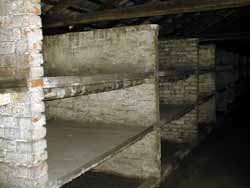
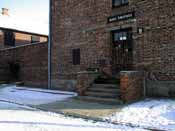
The reasons for the epidemics and contagious diseases that prevailed in Auschwitz concentration camp included the dreadful living conditions, which varied during the years that the camp operated, and were different in each part of the camp. In Auschwitz I, prisoners lived in old brick barracks. Several hundred three-tier wooden bunk beds were installed in each building. The overcrowding in Auschwitz I forced basements and lofts into use as living quarters, as well.
Two types of barracks, brick and wooden, housed prisoners in Birkenau concentration camp. The brick buildings were erected in great haste, without suitable insulation, on marshy ground. More than 700 people were assigned to each barrack, although in practice the figure was sometimes higher. These barracks lacked any true heating; nor did they contain sanitary facilities.
The second type of accommodation for prisoners at Birkenau consisted of wooden stable-barracks (Pferdestallbaracken). The interiors, designed to hold 52 horses, were partitioned into stalls. The stalls contained three-tier wooden bunks. Several hundred prisoners lived in each such barrack.
Dampness, leaky roofs, and the fouling of straw and straw mattresses by prisoners suffering from diarrhea made difficult living conditions worse. The barracks swarmed with various sorts of vermin and rats. A constant shortage of water for washing, and the lack of suitable sanitary facilities, aggravated the situation.
Living and sanitary conditions in Auschwitz III (Monowitz)concentration camp and the several dozen branch camps resembled those described above.
Feeding the Prisoners
Prisoners in the camp received meals three times a day: morning, noon, and evening. Factors influencing the nutritional value of the food included the official nutritional norms in the Nazi concentration camps. In practice, Auschwitz prisoners with less physically demanding labor assignments received approximately 1,300 calories per day, while those engaged in hard labor received approximately 1,700. After several weeks on such starvation rations in the camp, most prisoners began to experience organic deterioration that led to the so-called "Muzulman" state, extreme physical exhaustion that ended in death.
Order of the Day 
At Auschwitz, as in other concentration camps, the order of the day was strictly established. Prisoners spent over ten hours per day working, and the rest of the time was taken up by long roll-call assemblies, lining up for food rations or a place in the latrines or the washroom, removing dirt and pests from clothing, and disinfection.

Labor

A WVHA decree of March 31, 1942 established a minimum working day of eleven hours in all concentration camps. At Auschwitz, labor was one of the means used to destroy prisoners. They labored in various sectors of the economy. Initially, they worked at building the camp: leveling the ground, erecting new blocks and buildings, laying roads, and digging drainage ditches. Later, the industries of the Third Reich made increasing use of cheap prisoner labor. The pace of the work, the starvation rations of food, and constant beatings and abuse exacerbated the death rate. The German IG Farbenindustrie cartel, which built the Buna-Werke synthetic rubber and fuel factory at Monowice near Oswiecim, had priority in obtaining prisoner labor. The majority of the Auschwitz sub-camps were located near the mills, mines, and factories of Silesia. Prisoners dug coal, produced armaments and chemicals, and built and expanded industrial plants.

Executions

Executions were one means of physically liquidating prisoners and people brought from outside the camp. At first, people were shot to death in the pits near the camp from which gravel had been dug. From the autumn of 1941 until the autumn of 1943, most of the executions by shooting took place in the courtyard of Block No. 11 in the main camp. Most of the victims here were Poles, who received sentences of death by shooting from, for instance, the Gestapo summary court.
Soviet prisoners of war were also executed at Auschwitz concentration camp. Beginning in September 1941, executions were also carried out using poison gas.
At least 2,000 Soviet prisoners of war were put to death in this way. After the dismantling of the Death Wall in 1944, larger groups of Poles sentenced to death by the police summary court were executed in the gas chambers. Executions by hanging were carried out sporadically in the camp. As opposed to shooting or killing in the gas chamber, hanging was public. It was carried out in front of other prisoners, usually during roll call. The goal was to intimidate the witnesses, and the victims were most frequently prisoners caught trying to escape, or suspected of aiding escapers.
Source-http: https://www.jewishvirtuallibrary.org/jsource/Holocaust/auconditions.html

Concentration Camps, 1933-1945

The concentration camps, 1933-1945

The Nazis set up their first concentration camp, Dachau, in the wake of Hitler’s takeover of power in 1933. By the end of the war, 22 main concentration camps were established, together with around 1,200 affiliate camps, Aussenkommandos, and thousands of smaller camps. 
In 1945, when Allied forces liberated the concentration camps at Dachau, Bergen-Belsen, Buchenwald, Sachsenhausen, Auschwitz and elsewhere, the world was shocked at the sight of images of dead bodies alongside half-dead people in these camps. This was the remains of the Nazis’ horrible crime, to imprison people in camps because of their “otherness” or in order to use them for forced labour. 
A concentration camp was not the same as an extermination camp – camps constructed with the specific purpose of mass murdering Jews and other victim groups. Despite this fact, the concentration camps claimed many thousands of victims. Imprisonment in a concentration camp meant inhuman forced labour, brutal mistreatment, hunger, disease, and random executions. It is certain that several hundred thousand died in the concentration camps. In comparison, more than three million Jews were murdered in the extermination camps. 
At the beginning, the first inmates in concentration camps were political opponents of the Nazi regime. But ”different” people such as Jews, gypsies, and criminals were caught and placed in concentration camps – all in the name of the Nazis’ racial and regimentation ideology. 
It was the Reichstag Fire Decree of 28 February 1933 that provided the Nazis with the authority to detain people in ‘protective custody’ (Schutzhaft). This was the stepping stone to an organised and centrally directed camp system, which was placed under the direction of Heinrich Himmler as head of the SS and the police.
The camps could be divided into different categories according to their purpose and function: forced labour camps, work- and reformatory camps, POW camps, transit camps, police camps, women camps and ghetto camps. The extermination camps had a special position within the Nazi camp system. 

A typical concentration camp consisted of barracks that were secured from escape by barbed wire, watchtowers and guards. The inmates usually lived in overcrowded barracks and slept in bunk ”beds”. In the forced labour camps, for instance, the inmates usually worked 12 hours a day with hard physical work, clothed in rags, eating too little and always living under the risk of corporal punishment. 
The sick, the old and those who could not keep up with the work temp were “selected” and then killed with gas, injections or shot. Others were chosen for terrible pseudo-scientific experiments – most often losing their life. 
To this was added the horrible destiny that hit those prisoners who ended up as Muselmänner. This was the name for an inmate so undernourished that he or she was a living dead – a living, round-shouldered skeleton. The Muselmänner were either killed or died before they were executed. 

Forced labour

Forced  labour played an important role in the Nazi regime’s Jewish policy as well as for the economy of the concentration camps. Forced labour became particularly important following the outbreak of World War II, when the Nazi war economy demanded an enormous effort.
In connection with the ’Final Solution’, the Jews’ role as workers diminished as the extermination process was escalated. This was particularly apparent as far as the Polish Jews were concerned. A morbid form of forced labour was instituted in 1941, according to which Jews should be “worked to death”. 

In Auschwitz and Majdanek, which had the role of both being a working and an extermination camp, Jews were divided upon arrival into those capable of working ands those not. The last group was sent directly to the gas chambers, whereas those able to work had to work themselves to death in SS’s industries – or they were executed when they worn down. In Auschwitz, the Jews worked in the so-called Monowitz working camp (Auschwitz III) in factories, or they were hired out to private businesses such as the chemical corporation I.G. Farben or the SS’s own factories. 

Jews, especially German, Western European and Russian, also worked as slave labour in work camps in Germany. The Kraft durch Freude Volkswagen works in Wolfsburg, for example, used the “cheap” Jewish slave labourers. A tile work in Sachsenhausen, owned and operated by the SS, used Jews and other slave labourers. In the Harz, near the concentration camp Dora-Mittelbau, Jews worked in an underground weapons factory. 

The victims

It is impossible to estimate the exact number of victims for the concentration camp system and of those who fell victim to the death marches. 


The most current reliable figures from scholars are at least 500,000 and perhaps as many as over three-quarters of a million died as a result of the inhuman slave labour, hunger and disease in concentration camps. 


List of main concentration camps

Atotal of 22 main concentration camps (Stamlager) were established, together with approximately 1,200 affiliate camps. Besides these, thousands of smaller camps existed in all parts of German-controlled Europe. The 22 main camps, in alphabetical order, were as follows: Arbeitsdorf, Auschwitz, Bergen-Belsen, Buchenwald, Dachau, Flossenbürg, Gross-Rosen, Herzogenbosch, Kaunas, Krakow-Plaszow, Majdanek, Mauthausen, Mittelbau-Dora, Natzweiler-Struthof, Neuengamme, Ravensbrück, Riga-Kaiserwald, Sachsenhausen, Stutthof, Vaivara, Warsaw, Wewelsburg, Germany. 

Extermination camps

I
n the period of 1941-1945, for the first time in the history of mankind, industrial plants were used to kill people. A total of six extermination camps were established for the genocide of the Jews, where the Nazis carried out the mass murder of 3 million Jews – half of the 6 million victims of the Holocaust. 


Chelmno was the first extermination camp to be established as part of the ‘Final Solution to the Jewish Question’ – the Nazis’ systematic effort to exterminate the Jews.  This was quickly followed by the establishment of three more extermination camps: Belzec, Treblinka and Sobibor. They were established under the code-name Operation Reinhard – the starting signal to the extermination of the approximately 3 million Jews who lived in Nazi-occupied Poland. In the concentration camps Auschwitz-Birkenau and Majdanek two further extermination camps were established. 


The six extermination camps were all situated in former Poland and had mass murder as their purpose. Outside Poland at least two camps existed that in many ways resembled the six extermination camps in Poland: Jungfernhof (in Latvia) and Maly Trostinets (in Byelorussia). 


All of the extermination camps were thoroughly organised and resembled industrial plants to an alarming degree. However, only Auschwitz-Birkenau, with its advanced gassing facilities and crematoria, was marked by high technology. In crematoria I and II there were elevators from the gas chambers underground, where the Jews were murdered, to the crematoria, where the bodies were burned. 


The six extermination camps were established within a very short time. From December 1941 to December 1942 Chelmno, Belzec, Treblinka, Sobibor, Auschwitz-Birkenau and Majdanek all became operational. These sites were chosen because they were all situated near railway lines, in quiet rural areas of “far away” Poland, outside the spotlight of German and international public opinions. 

Six Extermination Camps

In Chelmno, the first extermination camp to be established with the single purpose of killing people – first of all Jews – in a systematic fashion, 152,000 inmates were gassed to death using exhaust gas from trucks, in the period of December 1941-March 1943, and again from June-July 1944.
The extermination camp Belzec was established in May 1942 and continued to function until August 1943. 600,000 Jews fell victim to the merciless efficiency of the gas chambers at Belzec. 
Sobibor also began its operations in May 1942. The killings continued through October 1943, when an uprising among the prisoners put and end to the activities of the camp. 250,000 lost their lives in Sobibor’s gas chambers.

The extermination camp Treblinka was working from July 1942 to November 1943. In August 1943 an uprising destroyed many of the facilities. 900,000 Jews lost their lives in this camp.    Auschwitz-Birkenau, which also functioned as a concentration camp and a work camp, became the largest killing centre. It is estimated that between 1 and 2 million were killed in the extermination camp Auschwitz-Birkenau. The first gassing experiments, involving 250 Polish and 600 Soviet POW’s, were carried out as early as September 1941. The extermination camp was started up in March 1942 and ended its work in November 1944.
Nine out of 10 victims in Auschwitz-Birkenau were Jews. The remaining victims were mainly Poles, gypsies, and Soviet POW’s. Majdanek began its gassings in October 1942. The camp functioned in the same way as Auschwitz-Birkenau, and also included a concentration- and work camp. In the autumn of 1943 the camp was closed after claiming between 60,000 and 80,000 Jewish victims. 

Killing methods

The use of gas chambers was the most common method of mass murdering the Jews in the extermination camps. The Jews were herded into the gas chambers, then the camp personnel closed the doors, and either exhaust gas (in Belzec, Sobibor and Treblinka) or poison gas in the form of Zyclon B or A (in Majdanek and Auschwitz-Birkenau) was led into the gas chamber.
Another method was the use of gassing trucks. In Chemno gassing trucks were used, where Jews, after being driven into the trucks, were suffocated by the exhaust fumes that were led into them in the truck. A third method was mass shooting of Jews and other groups (Soviet POW’s, Poles, etc.). In Majdanek, on 3-4 November 1943, between 17,000 and 18,000 Jews were killed in one day as part of a mass shooting. The event was called Erntefest (‘harvest feast’) and included similar actions all around the Lublin District. More than 40,000 Jews died as a result. 
When the victims arrived to the extermination camps in overcrowded trains, they were herded out onto the arrival ramp. Here, German SS-men and perhaps brutal Ukrainian guards forced them to hand over their belongings and their clothes. Most of the victims had been told that they were merely to be moved to the east for new jobs and living places, and most of them had brought their favourite belongings. 

In the “pure” extermination camps, men were separated from women upon arrival. The first to be gassed were the men – the women had their hair cut off before they went to their death. 
In the combined concentration- and extermination camps, Majdanek and Auschwitz, the SS chose those able to work for the work camps.
Those unable to work – the old, women and children – were immediately sent to the gas chambers or shot in the "camp hospital". Even those able to work ended up in the gas chamber sooner or later, or they fell victim to random shooting actions within a few months, when they had been worn out by the tough work. That is, if they had not died already. Those able to work for instance helped carry the bodies to the crematoria or search the bodies for valuables. 
The bodies were looted of gold (from the teeth), before being thrown into large mass graves. In time, the bodies were burned – either in mass graves or in the crematoria – when, as the Soviet armies advanced through Poland, the Nazis tried to hide their terrible crime.
There are few examples of uprisings in the extermination camps. In Sobibor and Treblinka prisoners tried to rebel in 1943, and the same was tried in Auschwitz in 1944. Only a very few managed to escape.
Source-http://www.projetaladin.org/holocaust/en/history-of-the-holocaust-shoah/the-killing-machine/concentration-camps.html

Killing Centers

KILLING CENTERS: AN OVERVIEW

The Nazis established killing centers for efficient mass murder. Unlike concentration camps, which served primarily as detention and labor centers, killing centers (also referred to as "extermination camps" or "death camps") were almost exclusively "death factories." German SS and police murdered nearly 2,700,000 Jews in the killing centers either by asphyxiation with poison gas or by shooting. 
CHELMNO, BELZEC, SOBIBOR, AND TREBLINKA
 
The first killing center was Chelmno, which opened in the Warthegau (part of Poland annexed to Germany) in December 1941. Mostly Jews, but also Roma (Gypsies), were gassed in mobile gas vans there. In 1942, in the Generalgouvernement (a territory in the interior of occupied Poland), the Nazis opened the Belzec, Sobibor, and Treblinkakilling centers (known collectively as the Operation Reinhard camps) to systematically murder the Jews of Poland. In the Operation Reinhard killing centers, the SS and their auxiliaries killed approximately 1,526,500 Jews between March 1942 and November 1943. 
AUSCHWITZ-BIRKENAU
 
Almost all of the deportees who arrived at the camps were sent immediately to death in the gas chambers (with the exception of very small numbers chosen for special work teams known as Sonderkommandos). The largest killing center was Auschwitz-Birkenau, which by spring 1943 had four gas chambers (using Zyklon B poison gas) in operation. At the height of the deportations, up to 6,000 Jews were gassed each day at Auschwitz-Birkenau in Poland. Over a million Jews and tens of thousands of Roma, Poles, and Soviet prisoners of war were killed there by November 1944. 
MAJDANEK
 
Though many scholars have traditionally counted the Majdanekcamp as a sixth killing center, recent research had shed more light on the functions and operations at Lublin/Majdanek. Within the framework of Operation Reinhard, Majdanek primarily served to concentrate Jews whom the Germans spared temporarily for forced labor. It occasionally functioned as a killing site to murder victims who could not be killed at the Operation Reinhard killing centers: Belzec, Sobibor, and Treblinka II. It also contained a storage depot for property and valuables taken from the Jewish victims at the killing centers. 
The SS considered the killing centers top secret. To obliterate all traces of gassing operations, special prisoner units (the Sonderkommandos) were forced to remove corpses from the gas chambers and cremate them. The grounds of some killing centers were landscaped or camouflaged to disguise the murder of millions.
Source- http://www.ushmm.org/wlc/en/article.php?ModuleId=10005145

Deportations to Concentration Camps

DEPORTATIONS TO KILLING CENTERS

The Nazi regime used rail transport as one method to forcibly rearrange the ethnic composition of eastern Europe within the framework of World War II. In 1941, the Nazi leadership decided to implement the "Final Solution," the systematic mass murder of European Jewry. The German authorities used rail systems across the continent to transport, or deport, Jews from their homes, primarily to eastern Europe. Once they had begun to methodically kill Jews in specially constructed killing centers, German officials deported Jews to these facilities by train or, when trains were not available or the distances were short, by truck or on foot. 
OFFICIALS COORDINATE MASS TRANSPORT BY TRAIN 
 
At the Wannsee Conference on January 20, 1942, held near Berlin, SS, Nazi Party, and German state officials met to coordinate the deportation of European Jews to killing centers (also known as “extermination camps”) already in operation or under construction in German-occupied Poland. The participants of the conference estimated that the "Final Solution" would involve the deportation and murder of 11 million Jews, including Jewish residents of nations outside German control, such as Ireland, Sweden, Turkey, and Great Britain. 
Deportations on this scale required the coordination of numerous German government agencies including the Reich Security Main Office (Reichssicherheitshauptamt—RSHA), the Main Office of the Order Police, the Ministry of Transportation, and the Foreign Office. The RSHA or regional SS and police leaders coordinated and often directed the deportations. The Order Police, often reinforced by local auxiliaries or collaborators in occupied territories, rounded up and transported the Jews to the killing centers. Working with department IV B 4 of the RSHA commanded by SS Lieutenant Colonel Adolf Eichmann, the Ministry of Transportation coordinated train schedules. The Foreign Office negotiated with Germany's Axis partners over the transfer of their Jewish citizens to German custody. 
The Germans attempted to disguise their intentions. They sought to portray the deportations as a "resettlement" of the Jewish population in labor camps in the "East." In reality, the "resettlement" in the "East" became a euphemism for transport to the killing centers and mass murder. 
INSIDE THE RAILCARS 
 
German railroad officials used both freight and passenger cars for the deportations. German authorities generally did not give the deportees food or water for the journey, even when they had to wait for days on railroad spurs for other trains to pass. Packed in sealed freight cars and suffering from overcrowding, they endured intense heat during the summer and freezing temperatures during the winter. Aside from a bucket, there was no sanitary facility. The stench of urine and excrement added to the humiliation and suffering of the deportees. Lacking food and water, many of the deportees died before the trains reached their destinations. Armed police guards accompanied the transports; they had orders to shoot anyone who tried to escape. 
Between December 1941 and July 1942, the SS and police officials established five killing centers in German-occupied Poland: Chelmno, Belzec, Sobibor, Treblinka 2 (Treblinka 1 was a forced-labor camp for Jews), and Auschwitz-Birkenau, also known as Auschwitz II. SS and police authorities in the Lublin District of the Generalgouvernement (that part of German-occupied Poland not directly annexed to Germany, attached to German East Prussia, or incorporated into the German-occupied Soviet Union) managed and coordinated the deportations to Belzec, Sobibor, and Treblinka within the framework of “Operation Reinhard.” 
THE VICTIMS 
 
The principal victims at Belzec were Jews from southern and southeastern Poland, but also Jews deported from the so-called Greater German Reich (Germany, Austria, the Sudetenland, and the Protectorate of Bohemia and Moravia) to District Lublin between October 1941 and the end of summer 1942. Most Jews deported to Sobibor came from the Lublin District; but German authorities also transported French and Dutch Jews to Sobibor in spring and summer 1943 and small groups of Soviet Jews from Belorussian and Lithuanian ghettos in late summer 1943. German officials transported the Jews from the Warsaw and Radom districts of the Generalgouvernement and from the Bialystok administrative district to Treblinka 2, where SS and police officials murdered them. German authorities deported most of the Jewish residents of the Lodz ghetto as well as the ghetto's surviving Roma and Sinti (Gypsy) residents to Chelmno between January 1942 and spring 1943, and then in early summer 1944. 
In 1943 and 1944, the Auschwitz-Birkenau killing center played a significant role in the German plan to kill the European Jews. Beginning in late winter 1943, trains arrived at Auschwitz-Birkenau on a regular basis carrying Jews from virtually every German-occupied country of Europe—from as far north as Norway to the Greek island of Rhodes off the coast of Turkey in the south, from the French slopes of the Pyrenees in the west to the easternmost reaches of German-occupied Poland and the Baltic states. Another concentration camp, located near Lublin and known as Majdanek, served as a site for murdering targeted groups of Jewish and non-Jewish prisoners by gas and other means. 
The Germans killed nearly three million Jews in the five killing centers. 
WESTERN AND NORTHERN EUROPE 
 
German officials and local collaborators deported Jews from western Europe via transit camps, such as Drancy in France, Westerbork in the Netherlands, and Mechelen (Malines) in Belgium. Of the approximately 75,000 Jews deported from France, more than 65,000 were deported from Drancy to Auschwitz-Birkenau, and approximately 2,000 to Sobibor. The Germans deported over 100,000 Jews from the Netherlands, almost all from Westerbork: about 60,000 to Auschwitz and over 34,000 to Sobibor. Between August 1942 and July 1944, 28 trains transported more than 25,000 Jews from Belgium to Auschwitz-Birkenau via Mechelen. 
In the autumn of 1942, the Germans seized approximately 770 Norwegian Jews and deported them by boat and train to Auschwitz. An effort to deport the Danish Jews in September 1943 failed when the resistance in Denmark, alerted to the impending roundup, assisted the mass escape of Danish Jews to neutral Sweden. 
SOUTHERN EUROPE 
 
The Germans deported Jews from Greece, from Italy, and from Croatia. Between March and August 1943, SS and police officials deported more than 40,000 Jews from Salonika, in northern Greece, to Auschwitz-Birkenau, where the camp staff killed most of them in the gas chambers upon arrival. After the Germans occupied northern Italy in September 1943, they deported about 8,000 Jews, most of them to Auschwitz-Birkenau. Based on an agreement with their Croatian Axis partner, German officials took custody of around 7,000 Croat Jews and deported them to Auschwitz-Birkenau. 
Bulgarian gendarmes and military units rounded up and deported around 7,000 Jewish residents of Bulgarian-occupied Macedonia, formerly a part of Yugoslavia, via a transit camp at Skopje. Bulgarian authorities concentrated approximately 4,000 Jews residing in Bulgarian-occupied Thrace at two assembly points in Bulgaria and transferred them to German custody. In all, Bulgaria deported more than 11,000 Jews to German-controlled territory. The German authorities deported these Jews to Treblinka 2 and killed them in the gas chambers. 
CENTRAL EUROPE 
 
German authorities began to deport Jews from the Greater German Reich in October 1941, while the construction of the killing centers was still in the planning stage. Between October 15, 1941, and November 4, 1941, German authorities deported 20,000 Jews to the Lodz ghetto. Between November 8, 1941, and October 1942, German authorities deported approximately 49,000 Jews from the Greater German Reich to Riga, Minsk, Kovno, and Raasiku, all in the Reich Commissariat Ostland (German-occupied Belorussia, Lithuania, Latvia, and Estonia). SS and police officials shot the overwhelming majority of the deportees upon arrival in the Reich Commissariat Ostland. German authorities deported another approximately 63,000 German, Austrian, and Czech Jews to the Warsaw ghetto and to various locations in District Lublin, including the transit camp-ghettos at Krasnystaw and Izbica and the killing center in Sobibor, between March and October 1942. German Jewish residents of the Lodz and Warsaw ghettos were later deported with Polish Jews to Chelmno, Treblinka 2, and, in 1944, to Auschwitz-Birkenau. 
The first transport of Jews from the Greater German Reich directly to Auschwitz arrived on July 18, 1942, from Vienna. From late October 1942 until January 1945, German authorities deported more than 71,000 Jews remaining in the Greater German Reich to Auschwitz-Birkenau. The Germans deported elderly or prominent Jews from Germany, Austria, the Protectorate of Bohemia and Moravia, and western Europe to the Theresienstadt ghetto, which also served as a transit camp for deportations further east, most often to Auschwitz-Birkenau. 
Between May and July 1944, Hungarian gendarmes, in cooperation with German security police officials, deported nearly 440,000 Jews from Hungary. Most of them were sent to Auschwitz-Birkenau. With the cooperation of Slovak authorities, the Germans deported more than 50,000 Slovak Jews to the concentration camps of Auschwitz-Birkenau and Majdanek. The Slovak Jews were the first to be selected for the gas chambers at Birkenau. In the autumn of 1944, German SS and police officials deported 10,000 Slovak Jews to Auschwitz-Birkenau during the Slovak uprising. This deportation was the last major one to a killing center. 
Between March 1942 and November 1943, the SS and police deported approximately 1,526,000 Jews, most of them by train, to the killing centers of Operation Reinhard: Belzec, Sobibor, and Treblinka. Between December 8, 1941, and March 1943 and again in June-July 1944, SS and police officials deported approximately 156,000 Jews and a few thousand Roma and Sinti to the killing center at Chelmno by train, by truck, and on foot. Between March 1942 and December 1944, the German authorities deported approximately 1.1 million Jews and 23,000 Roma and Sinti to Auschwitz-Birkenau, the overwhelming majority by rail. Fewer than 500 survived the Operation Reinhard killing centers. Only a handful of Jews survived the transports to Chelmno. Perhaps as many as 100,000 Jews survived deportation to Auschwitz-Birkenau by virtue of having been selected for forced labor upon arrival.

Source- http://www.ushmm.org/wlc/en/article.php?ModuleId=10005372